
Wayne Parole and Probation Compared
Michigan Department of Corrections Field Operations Administration manages felony parole and probation supervision. That shared agency can make the two terms look alike, yet their legal paths differ. Parole is release from secure state prison before the maximum sentence ends. The person lives in the community under MDOC authority and stated conditions. Probation is imposed by a court. It can begin without prison, or after a county jail term, and it remains tied to the sentencing court.
Wayne County is part of MDOC Metropolitan Territory, Region 10, which also covers Oakland and Macomb counties. An office assignment is not safe to guess from the county alone. The current OTIS profile and the official office directory control because assignments can change. A Wayne County arrest, bond release, or county-jail exit does not make someone a parolee. The court record may instead show pretrial monitoring or probation.
| Point | Parole | Probation |
|---|---|---|
| How it begins | Release from MDOC prison under Parole Board authority | Sentence ordered by a court |
| Prior prison required | Yes, for the sentence being paroled | No; a jail term may or may not come first |
| Public verification | OTIS status, date paroled, and supervision location | OTIS for covered active felony supervision, plus the court docket |
| How it ends | MDOC discharge or sentence termination | Court or MDOC discharge for the covered term |
Verify Wayne County Parole Status
The official starting point is the Michigan OTIS offender search. Search by MDOC number when it is known because that number is more precise than a name. A name search should be checked against identity details, sentence information, and the Wayne County case. OTIS covers current prisoners, parolees, probationers under MDOC supervision, and people discharged within three years. It does not cover a person whose only sentence was in county jail.
- Search OTIS by MDOC number or exact first and last name.
- Match the identity, Wayne County sentence, and offense information before using the result.
- Read Current Status with Location or supervision office. Do not rely on one field alone.
- Open the current MDOC parole and probation office directory for Region 10.
- For formal proof that supervision ended, request the Discharge Certificate or releasable MDOC record.
A result marked “Parole” confirms that secure prison custody ended and community supervision began. “Probation” confirms the displayed supervised sentence, but does not prove a prison stay. “Discharged” means the displayed MDOC sentence or supervision ended. If nothing appears, consider OTIS limits, a jail-only case, spelling, and the three-year public window before drawing a conclusion.
When the Wayne County case began with a jail booking, compare the state profile with the court docket. A bond release can place a defendant with Third Circuit Pretrial Services, but that program is not MDOC parole. A sentence may also include county jail followed by probation. The judgment identifies that structure. If the jail entry instead says transfer to MDOC, the judgment and later OTIS profile should share the same Wayne County case and sentence. This cross-check prevents an ordinary pretrial release from being described as parole and prevents a prison transfer from being described as release to the community.
The official MDOC Region 10 directory shows how Wayne County supervision offices are located:
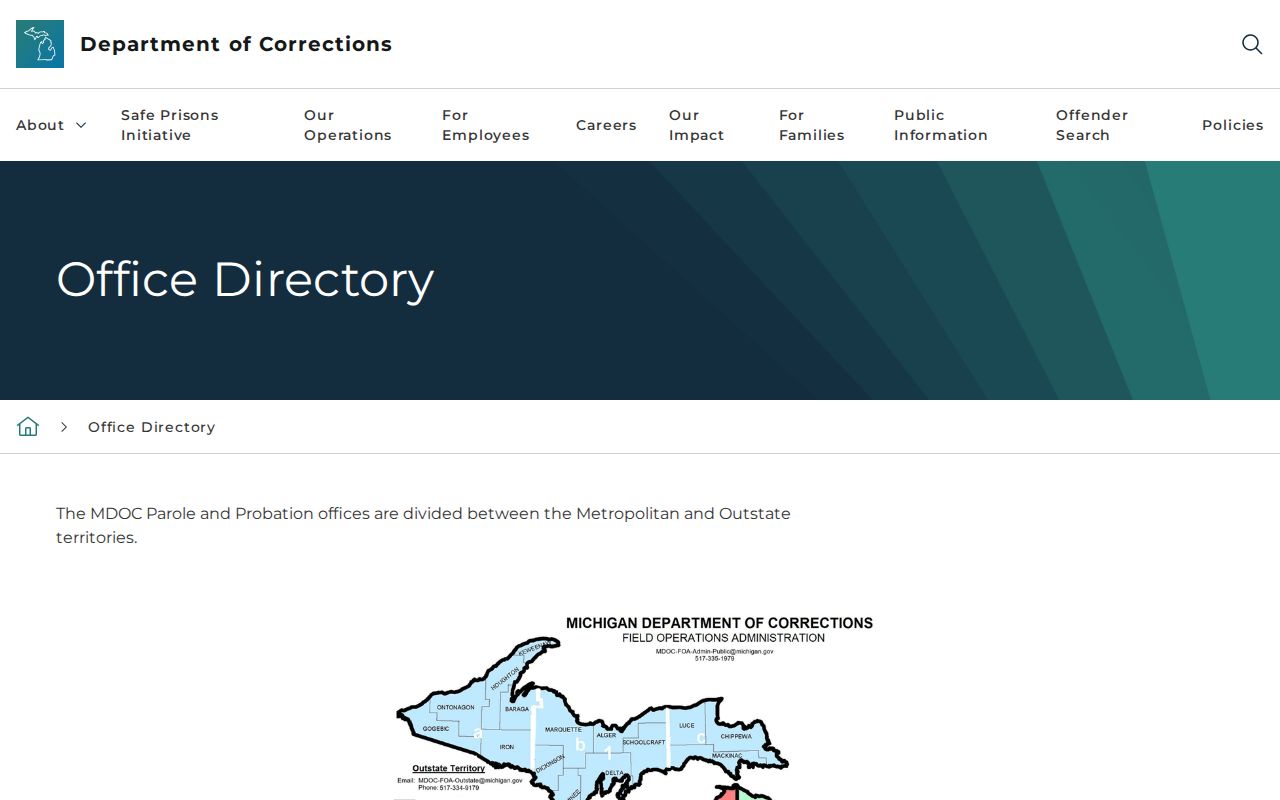
The directory should be checked again on the day of contact because an OTIS office assignment or directory entry may change.
Note: A current parole grant is not the same as a recorded prison release; look for Date Paroled or agency confirmation.
Wayne Supervision Record Terms
Corrections terms describe different stages. Reading them as synonyms can turn a valid result into a false claim. The exact agency wording and date should be preserved when documenting Wayne County post-release supervision.
- Parole
- Community supervision after release from an MDOC prison while the sentence remains active.
- Probation
- A court-ordered sentence served under stated supervision terms, often without a prison term.
- Discharge
- The formal end of the displayed sentence or supervision term.
- Absconder
- A person whose active supervision includes an unresolved failure to report or whose location is at issue.
- Detainer
- A request or hold from another authority that can affect custody or release.
An absconder status does not mean supervision ended. It indicates an active concern, not a clean discharge. Likewise, a parole location is an agency office, not permission to publish a private home address. Formal records are available through MDOC records channels when a public profile does not answer the narrow question.
Wayne Parole Office Contacts
Wayne County supervision falls within Metropolitan Territory, Region 10. Use the office displayed on the OTIS record, then compare it with the live directory. For a general records or agency question, MDOC maintains statewide contact channels. The Parole Board handles parole authority, while Field Operations staff supervise active cases.
Michigan Department of CorrectionsGrandview Plaza
206 E. Michigan Avenue
P.O. Box 30003
Lansing, MI 48909
517-335-1426
CorrectionsInfo@michigan.gov
Weekdays, 8 a.m. to 5 p.m. Eastern
The Michigan Parole Board can be reached at 517-373-0270 or Parole-Board-Staff@michigan.gov. Those contacts do not replace the assigned field office. When a profile seems wrong, send court-originated facts to the sentencing court first. A supervision-status error belongs with the listed office or agent, while technical OTIS problems belong with the system contact.
A person seeking a durable status record can ask MDOC for a Discharge Certificate or the releasable part of a PENPACK. MDOC describes the packet as potentially containing the Judgment of Sentence, Parole Eligibility Report, identity documents, a photo if available, and the certificate, subject to access restrictions. Current prisoner records and past-prisoner records use different MDOC routing addresses. A narrow request that gives the MDOC number, sentence, and exact status question is easier to route than a demand for every file.
Wayne Supervision Violations and Discharge
Conditions are the rules attached to parole or probation. They may address reporting, travel, treatment, payments, or conduct, but only the official order and agency record state the terms for one person. A public profile is not a compliance report. It should not be used to infer that every condition has been met or broken.
A violation can lead to agency review, a warrant, or court action. An “absconder” label means the person has not completed supervision merely because the reported location is unknown. MDOC lists an Absconder/Escapee Tip Line at 517-755-0855. Immediate danger belongs with 911. For custody alerts tied to a participating record, MI-VINE can provide release, transfer, or escape notices, but it does not replace the supervising office.
Supervision ends through discharge, not through silence in a search. OTIS ordinarily retains a discharged public profile for three years after supervision ends. A formal Discharge Certificate may be requested as part of the available records for paroled or discharged people, subject to access limits. The Wayne County released inmate search path explains how a county booking, court order, and state status fit together.
Parole hearings add another timing trap. Routine interviews are not all listed on the public clemency registration calendar, and quarterly Parole Board reports are aggregate. A missing name on that calendar does not mean no review occurred. A grant, denial, or deferral belongs with the person’s official decision, authorized notification, or MDOC record. Even a grant can be suspended before the planned exit. Physical release is best supported by Date Paroled, a custody-change notice tied to MDOC, or direct agency confirmation.
Note: Record the agency, exact status, and update date so parole, probation, discharge, and custody changes remain distinct.
Wayne County Reentry After Release
Wayne County has local programs that support a return to the community, but those programs do not verify release or supervision. Wayne County Community Corrections receives referrals from courts, MDOC, and WCSO for programs and case management. The referral source and service plan matter. Participation alone does not establish parole, probation, or discharge.
Wayne County Jail Health Services also describes discharge planning and an Inmate Support and Liaison Program that links people with community services. That is a navigation and care function. Custody status still comes from WCSO for a county booking, OTIS and MDOC for a state sentence, and the court for the legal disposition.
This local split is useful. A family can use service programs for practical support while keeping records questions with the agencies that own them. It also prevents a case-management referral from being mistaken for proof that supervision has begun or ended.
Wayne Parole ID Records
In September 2025, the Michigan Secretary of State and WCSO announced expanded mobile state ID services for newly paroled Wayne County residents. The program can help an eligible person receive a state identification card or driver’s license upon release. It is a concrete post-release document path, not a custody search or parole status record.
The Secretary of State announcement should be read for current program scope. An ID does not replace the OTIS profile, parole order, or discharge certificate. Conversely, an error in OTIS may require a court correction before a state record can be updated. Keeping identity and corrections records aligned helps prevent the wrong Wayne County case from being matched to the wrong person.