
MDOC Statewide Release Routes
Wayne County state prisoners are designated across Michigan. They do not remain in the county jail system merely because the conviction came from a Wayne court. A transfer from WCSO to MDOC ends one county booking but begins state imprisonment. OTIS becomes the primary public locator after MDOC intake and data processing.
A state prisoner may later leave secure confinement on parole. That person lives outside prison but remains under MDOC authority. A prisoner may also reach the lawful maximum and discharge, or a court order can alter the sentence. “Discharged” closes the displayed state sentence or supervision. Neither label decides whether an unrelated county, federal, or immigration matter exists.
| MDOC status | Release meaning | Required caveat |
|---|---|---|
| Prisoner | Still in state secure custody | Earliest date is not actual release |
| Parole | Left prison for community supervision | Sentence remains active |
| Probation | Covered court supervision | Does not prove a prison stay |
| Discharged | Displayed MDOC term ended | Other cases may remain |
| Absconder | Active supervision concern | Not a discharge |
The county jail roster is the wrong source for a person already sent to MDOC. In the other direction, OTIS excludes county-jail-only and city-lockup cases. Selecting the custodian first prevents a valid search from being used outside its scope.
Search MDOC Wayne Release Records
The Offender Tracking Information System, known as OTIS, is the public first step. Search by MDOC number when possible. A number from the judgment or prior state record avoids many same-name errors. When only a name is available, compare identity, Wayne County sentence details, offense information, and dates.
- Open OTIS and search by MDOC number or exact name.
- Match the profile to the Wayne County judgment and identity facts.
- Read Current Status and Location or supervision office.
- Compare Earliest Release Date, Maximum Discharge Date, and Date Paroled or Discharged.
- Use the listed field office for active supervision and MDOC records for formal proof.
- Check the receiving agency when the record suggests another custody system.
The official OTIS entry page shows the statewide release-search route:
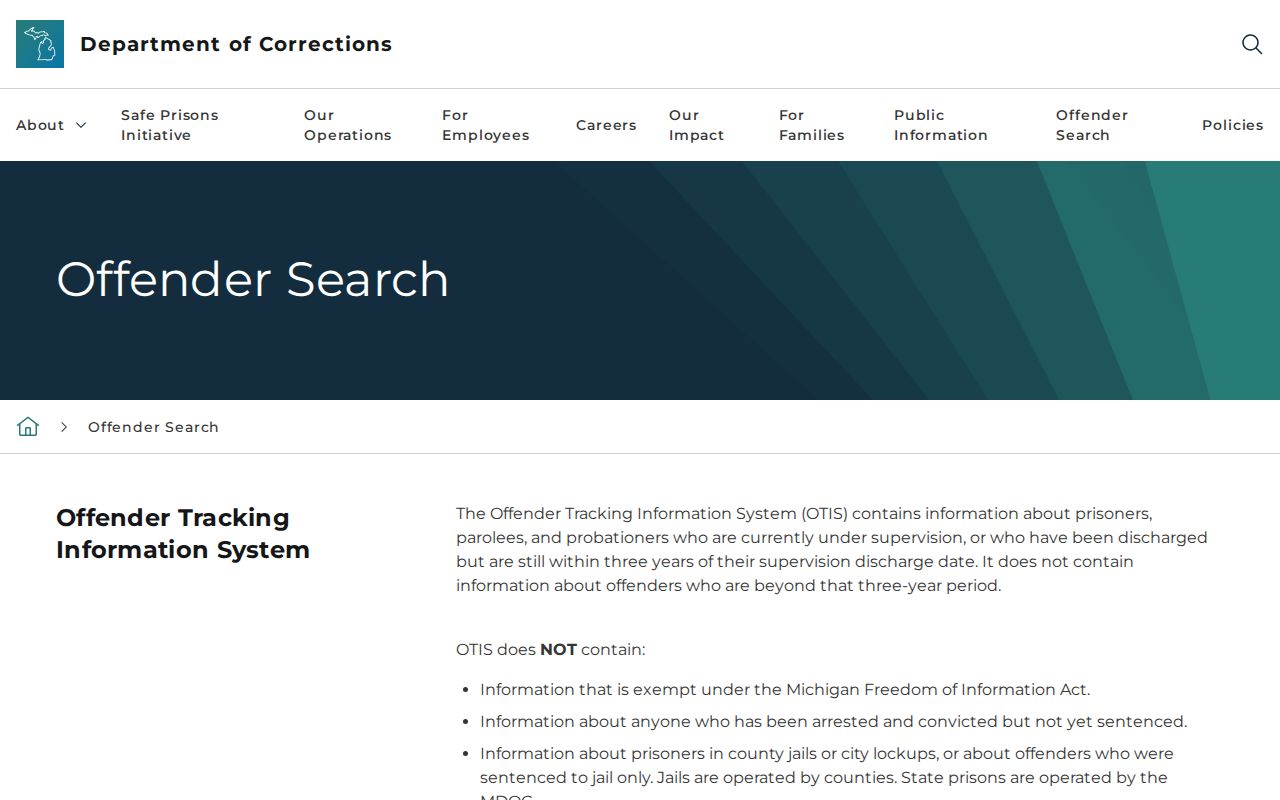
A public OTIS profile can remain available for three years after supervision discharge. After that point, use MDOC past-prisoner records or FOIA rather than stating that no record exists. OTIS also can omit information that is exempt or outside its covered population.
Note: Preserve the exact MDOC status and its date because parole, discharge, and prison custody are not interchangeable labels.
MDOC Wayne Release Date Fields
Michigan state sentences often use a minimum and maximum. OTIS calls the lower date Earliest Release Date. It is generally the point when the Parole Board may first gain jurisdiction, not a promised exit. The Maximum Discharge Date is the outside state sentence date as currently computed. Date Paroled is the stronger public indicator that prison release actually occurred.
Modern Truth in Sentencing cases require the full judicial minimum in secure confinement before parole consideration. Michigan does not apply a general 85 percent shortcut. Older offenses may receive historical credits under the law that governed when the offense occurred. MDOC performs the computation from the judgment, offense date, sentence start, jail credit, and concurrent or consecutive structure.
- Earliest Release Date
- The minimum-based date when parole jurisdiction may begin.
- Maximum Discharge Date
- The current outside endpoint of the state sentence.
- Date Paroled
- The recorded move from prison to parole supervision.
- Discharge Certificate
- A formal MDOC record documenting termination of the sentence or supervision.
A date can change after an amended judgment, corrected jail credit, appellate order, sentence-structure decision, parole grant or suspension, or data correction. Compare unexpected changes with the sentencing court and MDOC Time Computation.
A Wayne County court record is central to that comparison. The Judgment of Sentence states the minimum and maximum, jail credit, and whether terms run concurrently or consecutively. The offense date identifies which credit law may apply. When court data is wrong in OTIS, the correction should begin with the sentencing court. A supervision-location or active-status issue belongs with the listed MDOC office or agent.
MDOC Wayne Parole Process
The Michigan Parole Board is the sole paroling authority for felony offenders committed to MDOC. It generally gains jurisdiction at the minimum or earliest date under MCL 791.234. A positive decision still is not the physical release. The Parole Release Unit coordinates placement, date, term, and special conditions, and a grant can be suspended if adverse information or misconduct arises before exit.
The MDOC parole consideration process explains this gap between eligibility, decision, and release:
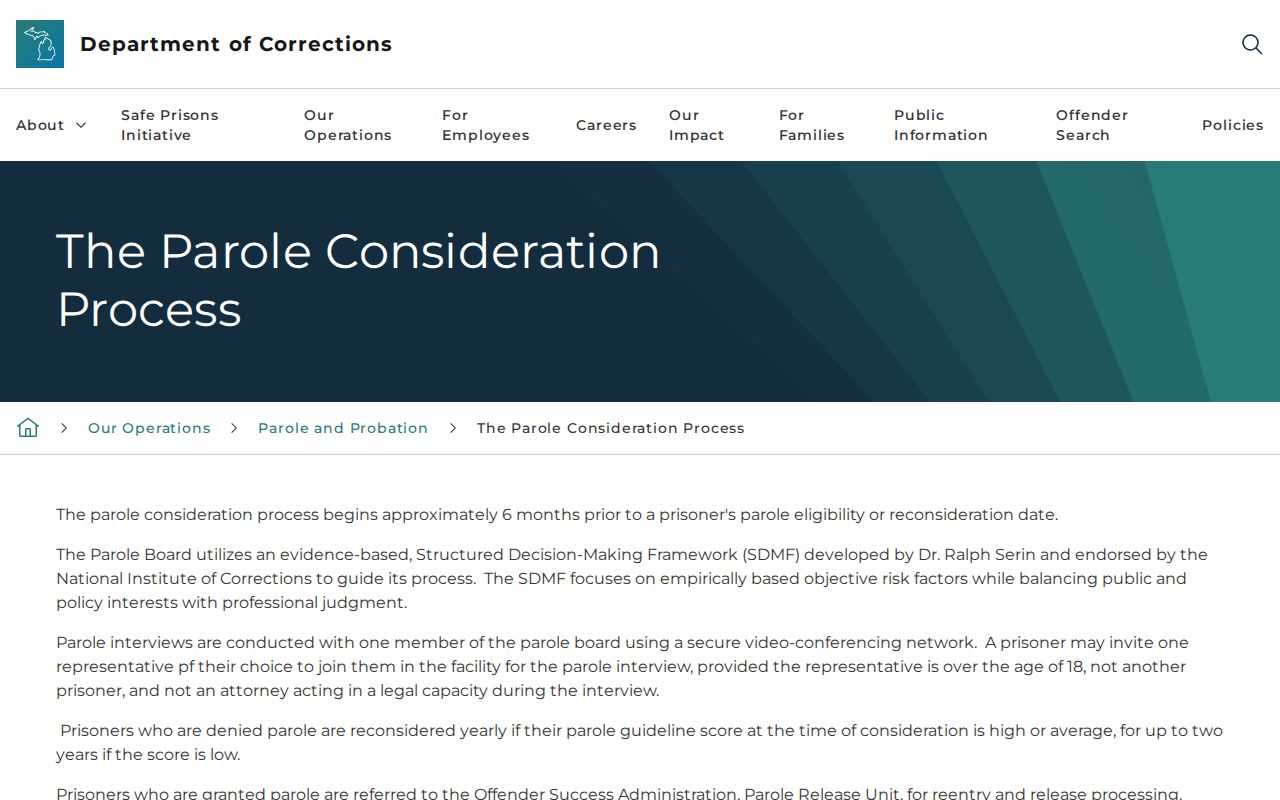
OTIS Date Paroled, an MDOC release record, or an agency-fed VINE event is needed to confirm the transition. A Board grant by itself supports “parole granted,” not “released from prison.”
Routine parole interviews do not appear on a complete public name-by-name calendar. Public registration pages cover specified public matters, such as noticed clemency hearings, and quarterly reports contain aggregate decisions. Neither source replaces an individual decision document, OTIS status, or an authorized MDOC record.
MDOC Statewide Discharge Records
When the public profile is not enough, ask for the record that answers the question. MDOC’s FAQ says a PENPACK for a paroled or discharged person can include certified copies of the presentence investigation report, Basic Information Sheet, Parole Eligibility Report, photo if available, fingerprints, Judgment of Sentence, and Discharge Certificate. Some parts may be restricted.
Current prisoner records can be directed to Corr_Records_Info@michigan.gov. Past prisoner records up to six years post-release can be directed to MDOC-Records_Retention@michigan.gov, while MDOC-FOIA@michigan.gov handles FOIA. Ask for the Discharge Certificate or specific releasable fields instead of requesting an undefined complete file. Court judgments should come from the sentencing clerk.
Michigan FOIA applies subject to exemptions. A public OTIS summary and a formal discharge record serve different needs. The summary is fast and dated. The certificate provides a more durable agency artifact. The Wayne County release-record path explains how the state packet connects with the county booking and court order.
Note: An OTIS profile that leaves public view after the three-year window may still be available through authorized records channels.
MDOC Statewide Release Contacts
MDOC headquarters provides routing for state records and corrections questions. Active parole or probation matters should go to the office shown in OTIS and the current Region 10 directory, because office assignments change.
Michigan Department of CorrectionsGrandview Plaza
206 E. Michigan Avenue
P.O. Box 30003
Lansing, MI 48909
517-335-1426
CorrectionsInfo@michigan.gov
Weekdays, 8 a.m. to 5 p.m. Eastern
The Michigan Parole Board is available at 517-373-0270 and Parole-Board-Staff@michigan.gov. MI-VINE is available at 800-770-7657 for participating custody notifications. Those channels do not replace the sentencing court or a named receiving custodian.
At Wayne County’s Criminal Justice Center, an MDOC office is listed in Suite 450 with 313-202-7333. Co-location with WCSO, the court, and clerk does not merge their records. The jail confirms county custody, the court explains the judgment, and MDOC confirms state imprisonment and supervision.
MI-VINE offers another state channel for participating custody events. A person can be searched by name after Michigan is selected, and notification methods may include phone, email, text, or app. A VINE release notice should be attributed to the reporting agency. It can corroborate an MDOC transition, but the legal basis and formal discharge still come from MDOC and the court.
Wayne MDOC Facility History
There is no current MDOC prison in Wayne County comparable to the former Detroit Reentry Center. Wayne County residents sentenced to prison can be housed anywhere in the state. A prison location on OTIS, not the county of conviction, identifies the current state facility.
The Detroit Reentry Center, formerly Ryan Correctional Facility, closed in 2021. Historical documents may still use either name. Wayne County also shifted major criminal justice operations to the new Russell Street Criminal Justice Center in September 2024. Both changes create stale search results, so facility names and addresses need a date.
These facts affect release searches. An old DRC record should lead to OTIS and MDOC archives, not a trip to a closed prison. A current county booking belongs with WCSO at the CJC, not OTIS unless the person later enters state jurisdiction. Clear operator labels keep the timeline accurate.
Successive custody also reaches beyond Michigan. A federal defendant belongs in the BOP locator, where a displayed release date can change after credit recalculation. ICE uses its own detainee locator. A WCSO or MDOC transfer to either system should be reported as a transfer, then checked with the receiving agency. Wayne County identifies the case connection, not the current custodian.