
Wayne Projected and Actual Release
“Projected” is a planning term. The official systems use more exact labels. OTIS calls the lower state-prison date the Earliest Release Date and also displays a Maximum Discharge Date. The first date is when the Michigan Parole Board may gain jurisdiction under the sentence and governing law. It is not an appointment for pickup. The maximum is the sentence endpoint as lawfully computed, not the expected parole day.
County custody works differently. A sentenced Wayne County jail prisoner may have a definite term, jail credit, and eligible good time. WCSO performs the actual calculation from the commitment record. A pretrial detainee has no sentence-based date. Bond may be posted, a judge may change an order, a charge may be resolved, or another agency may lodge a hold.
A state “Date Paroled” confirms the transition from prison to supervision. A county release entry confirms only departure from WCSO custody unless it also states the destination. Transfer to MDOC, another county, federal authorities, or ICE is not community release. Those distinctions prevent a valid date from being given the wrong meaning.
Find Wayne County Release Dates
Start with the last known custodian. Use the WCSO inmate inquiry for a county booking and OTIS for a state sentence. The court judgment is the bridge when a person moves from county jail to state prison. It supplies the minimum and maximum terms, sentence start, jail credit, offense date, and whether terms run at the same time or one after another.
- For WCSO custody, match the name, subject number, booking number, docket, and booking date.
- Check the custody field and look for an explicit release date or transfer. A blank facility field is not a release date.
- For an MDOC sentence, search OTIS by MDOC number and open the exact profile.
- Read Current Status, Earliest Release Date, Maximum Discharge Date, and Date Paroled or Discharged together.
- Compare a surprising date with the signed judgment and contact the sentencing court or MDOC record office for correction.
- Confirm the actual exit with the custodial agency or a custody-change notice.
The official MDOC OTIS search shows the state system entry point:
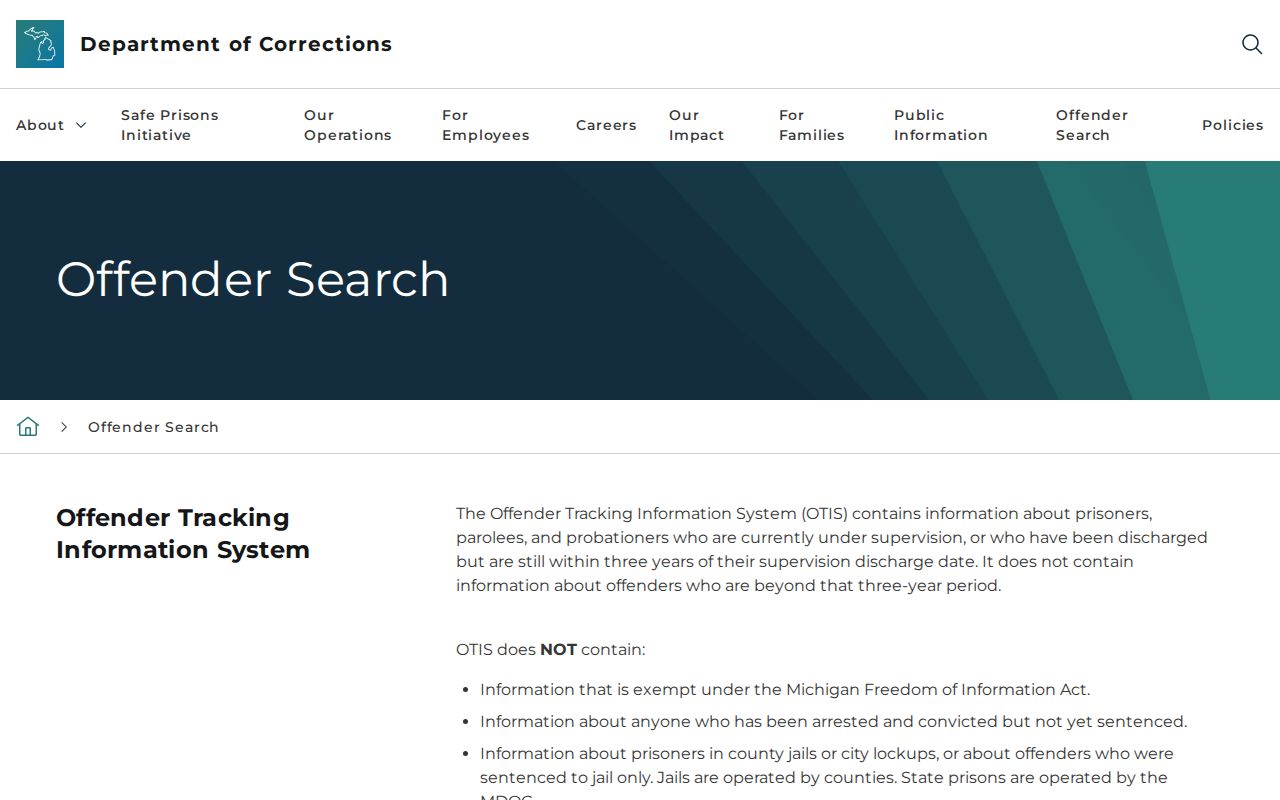
OTIS excludes county-jail-only people and city-lockup stays. It also removes discharged public profiles after three years, so no result is not proof that no state sentence existed.
For a county record that lacks a clear release field, call WCSO inmate information at 313-224-0797 or request the booking and release log. The Wayne County released inmate lookup gives the full county, court, VINE, state, and federal verification chain.
The court file supplies facts neither locator can safely invent. The register of actions and signed judgment can show bond, sentence length, jail credit, amended terms, and later orders. For a felony commitment, those facts connect the WCSO booking to the MDOC profile. For a definite county jail term, they establish the starting inputs that WCSO applies. If the person is only awaiting trial, the docket may show bond or a release order, but no sentence-based projected date exists.
Note: Use an MDOC number whenever possible because a Wayne County conviction and common name may not identify one state profile.
Wayne State Release Date Fields
Michigan uses indeterminate sentencing for most state felonies. The court sets a minimum and a maximum under MCL 769.8. MDOC then applies the judgment and the law that governs the offense. The result is not one simple countdown.
| OTIS field | What it means | What it does not prove |
|---|---|---|
| Current Status | Prisoner, parole, probation, discharged, or another displayed state status | The full history of other custody systems |
| Earliest Release Date | Minimum-based point when Board jurisdiction may begin | A guaranteed prison exit |
| Maximum Discharge Date | Outside state sentence date as currently computed | The expected parole day |
| Date Paroled | Recorded transition from prison to parole status | End of the sentence or supervision |
| Date Discharged | Recorded end of the displayed MDOC sentence or supervision | Resolution of an unrelated case |
Under MCL 791.234, the Parole Board has jurisdiction and special limits set by offense and sentence type. Eligible lifers and nonparolable categories require separate analysis. An earliest date can pass without parole. A grant can also be suspended before release if new misconduct or adverse information arises.
Wayne Prison Truth In Sentencing
Modern Michigan Truth in Sentencing rules require people convicted of covered offenses to serve the entire judicial minimum in secure confinement before parole consideration. Michigan does not use a broad “serve 85 percent” rule for these state cases. That shortcut is inaccurate and can produce a false projected release date.
The MDOC Truth in Sentencing explanation documents the state framework:
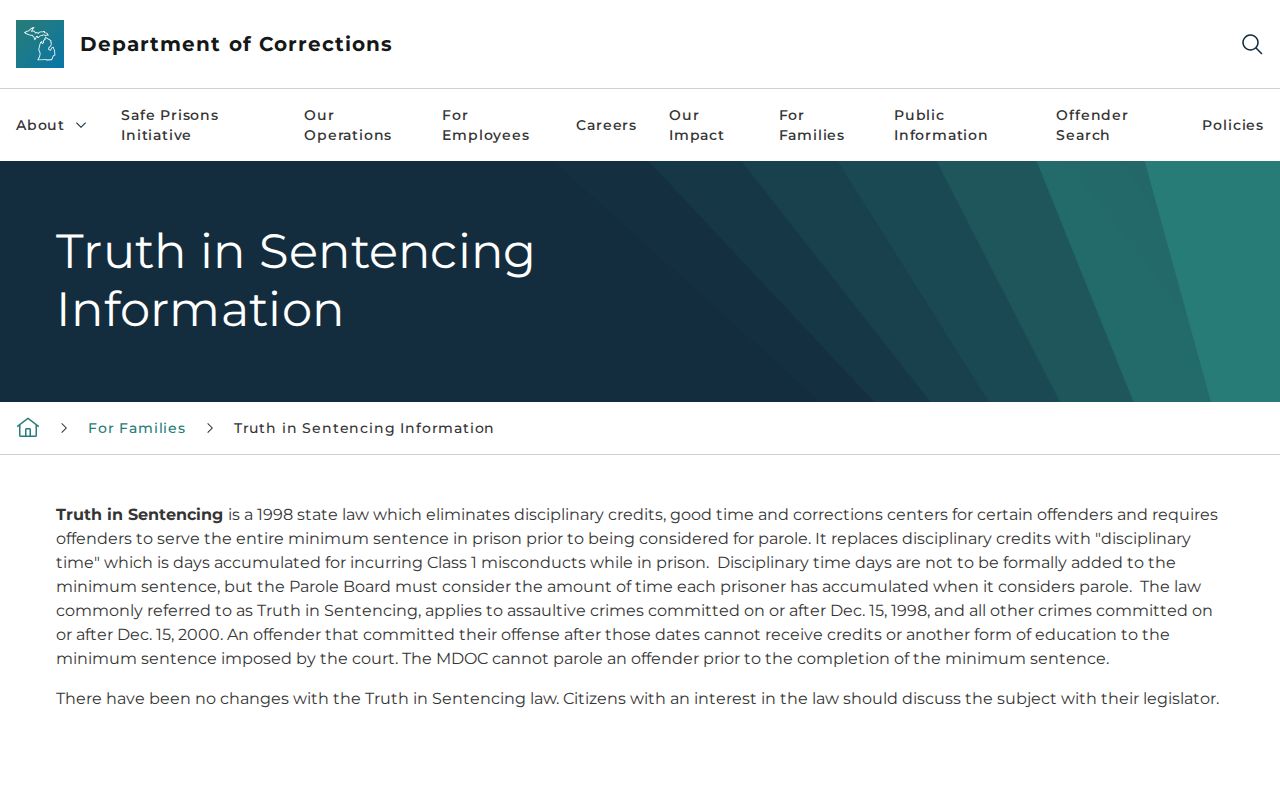
The guidance is relevant to a Wayne County defendant sent to MDOC anywhere in Michigan. It does not govern a definite Wayne County jail term.
Older offense dates may retain good-time or disciplinary-credit treatment under the law in force when the offense occurred. That is why the offense date, sentence date, and judgment all matter. MDOC Time Computation, not a homemade formula, determines the state dates. The Board then decides whether and when parole follows eligibility.
Parole jurisdiction also differs from discharge. Once the minimum date arrives, the Board may grant, deny, or defer under the controlling statute and case facts. A granted parole can still be suspended before release. If parole occurs, the person leaves prison but continues under MDOC supervision until discharge. Maximum discharge is the outside sentence date, not a prediction that the person will remain in prison until then. These labels should be copied exactly when sharing an expected Wayne County release timeline.
Wayne Jail Good Time Rules
Wayne County sentenced prisoners fall under a different statute. MCL 51.282 gives an eligible county prisoner one day of sentence reduction for each six days when the conduct record shows no rule violation. The Sheriff may forfeit or restore eligible good time. MCL 51.283 addresses notice of the rules and the prisoner’s duty to call entitlement to release to the sheriff’s attention.
That ratio is not a public release-date calculator. WCSO still must apply the judgment, sentence start, credit for time already served, disciplinary record, holds, and later court orders. A thirty-day sentence can have good-time implications, but only the recorded computation controls. Pretrial bond cases do not receive sentence good time because they do not yet have a definite jail sentence.
No official Wayne County weekend or holiday early-release rule was found. There is also no published release-hour schedule. A family should not rely on a guessed Friday exit or make travel plans from an estimate. Ask WCSO for the current recorded date and confirm the actual change when it occurs.
Other holds are part of the county calculation’s practical result even when they do not alter the sentence length. A person can finish the Wayne County term yet move to MDOC, another county, federal authorities, or immigration custody. Ask whether the recorded event is community release or transfer. The release log and receiving agency are stronger than the disappearance of a name from a live roster. If the destination is not public, request any releasable transfer field and continue with the likely custodian.
Note: County good time and state parole eligibility are separate rules, even when the same Wayne County court case connects both systems.
Why Wayne Release Dates Change
A displayed date is a current computation. Courts and agencies can receive new facts or correct old ones. A change should be traced to its source before it is described as error.
| Change | Possible effect | Best record |
|---|---|---|
| Amended judgment or appeal | Minimum, maximum, credit, or sentence structure changes | Signed court order |
| Corrected jail credit | Moves the computed county or state date | Judgment and agency computation |
| Concurrent or consecutive terms | Terms overlap or run one after another | Judgment of Sentence |
| County rule violation | Eligible jail good time may be forfeited or later restored | WCSO computation record |
| New hold or detainer | Departure from one custodian may become transfer | Release and receiving-agency record |
| Parole grant or suspension | Changes expected state-prison exit | Board decision and OTIS Date Paroled |
| Data correction | Portal fields change without a new court event | Agency correction response |
Court-originated errors should go first to the sentencing court. OTIS supervision-status errors belong with the listed office or agent. MDOC accepts questions about inaccurate, outdated, or incomplete information through its published contact channels. Keep a copy of the date, field label, and source that prompted the question.
Federal and state dates should not be blended. The BOP locator reports federal release data and warns that First Step Act credit recalculation can change a displayed date. Federal supervised release is a court status, not Michigan parole. ICE uses its own locator, and a local release to ICE is a transfer. A Wayne County connection identifies the case context, but it does not make OTIS the right source for every custody system.
Confirm Wayne County Actual Release
A projection becomes history only after the reporting agency records the event. For WCSO, use the booking detail, phone confirmation, court order, VINE event, or a focused release-record request. For state prison, OTIS Date Paroled, a VINE notice, or an MDOC record can confirm the exit from secure confinement. Parole means continued supervision, while discharge means the displayed state term has ended.
VINELink can send a notice for a participating record. Its alert reports what the feeding agency supplied and should be checked against that agency. The Wayne County VINELink release check explains the one-person search and notification process. Federal dates belong in the BOP locator, and immigration custody belongs with ICE, not OTIS.
When formal proof is needed, ask MDOC for a Discharge Certificate or releasable portions of the PENPACK for a state case. Ask WCSO for the booking sheet, recorded release date and time, authority or reason code, and transfer destination when releasable. The court clerk remains the source for the judgment and later orders.
Save the source date with each result. Portal data can change after a court correction, agency update, or new custody event. A dated copy of the exact field labels makes later comparison possible and keeps a projected date separate from the final recorded release.