
Detroit Reentry Center Is Closed
MDOC’s official closed-facility record states that Detroit Reentry Center closed on January 9, 2021. It formerly held prisoners, probationers, and alleged parole violators. It is not a current release location. Any page or directory that presents DRC as an operating prison should be checked against that closure date.
The facility was also known as Ryan Correctional Facility. Both names matter in a historical search because a judgment, transfer paper, parole file, or news report may use the name current at that time. The address associated with the former facility is 17600 Ryan Road in Detroit. That address identifies a closed site, not a place to seek a present-day prisoner.
The closure record is the starting point for understanding old references. It does not by itself establish what happened to one person. A matched MDOC number, sentence, status, and date are still required.
The official MDOC closed-facility page preserves the historical context:
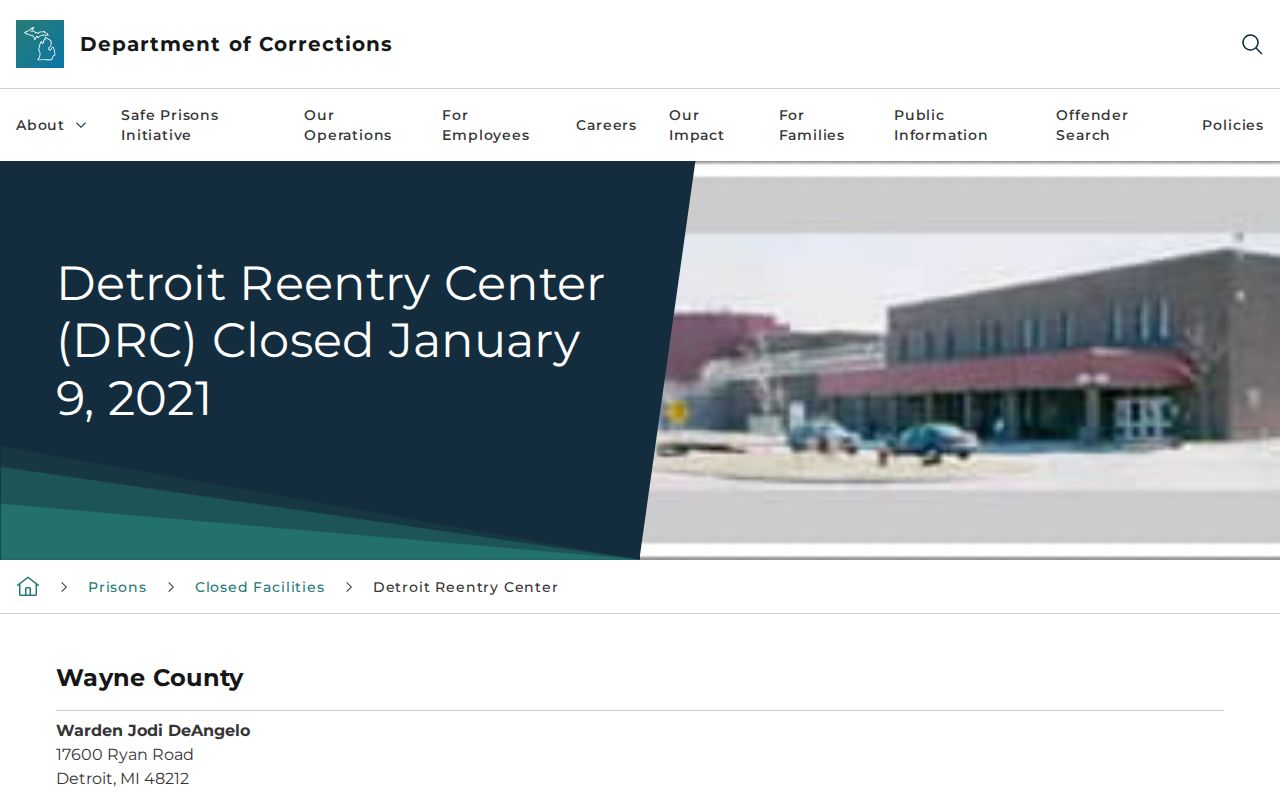
The image supports the closure history. It is not evidence of a current occupant, release schedule, or contact desk.
Detroit Reentry Historical Release Routes
A person who left DRC before closure may have moved to another MDOC prison, entered parole, discharged at the maximum, returned to supervision after a parole-violation process, or transferred under another authority. “Released from DRC” can therefore mean departure from one building while state custody continued.
| Historical event | Meaning | Best record |
|---|---|---|
| Transfer to another prison | State incarceration continued | OTIS location history or MDOC record |
| Parole | Secure prison ended; MDOC supervision continued | OTIS Date Paroled and parole record |
| Discharge | Displayed state sentence or supervision ended | Discharge Certificate |
| Parole-violation movement | Custody or supervision status changed | MDOC decision and custody record |
| Other-agency transfer | A different custodian took control | Transfer record and receiving agency |
Historical wording should name the agency and date. “MDOC recorded parole on the displayed date” is more accurate than saying the person was simply free. Parole remained a supervised status, and another hold could affect the actual destination.
Wayne County’s jail inquiry is not the primary archive for a DRC state-prison event. It may document the earlier county booking and transfer to MDOC, but the state sentence and release belong with OTIS, MDOC, and the sentencing court.
Search Detroit Reentry Release Records
Begin with the MDOC OTIS search. An MDOC number is the strongest key. If only a name is known, compare identity details, the Wayne County judgment, offenses, dates, and any former DRC location reference. Avoid joining two profiles just because their names match.
- Search OTIS by MDOC number or exact name.
- Match the state sentence and identity to the historical DRC record.
- Read Current Status, location, Earliest Release Date, Maximum Discharge Date, and Date Paroled or Discharged.
- Check whether the person transferred to another prison before parole or discharge.
- Request a Discharge Certificate or facility-history record when the public profile is incomplete.
- Use the sentencing court for the judgment and later amended orders.
OTIS includes current prisoners, parolees, covered probationers, and discharged people for three years after supervision discharge. A person released from DRC long ago may therefore be absent from public OTIS even though MDOC retains other records. No result must be described as “not found in current public OTIS,” not “no record.”
The Wayne County released inmate lookup can reconnect the historical state record to an earlier WCSO booking or court case when the original custody path is unclear.
Note: Search both Detroit Reentry Center and Ryan Correctional Facility when describing the record sought from MDOC.
Detroit Reentry Record Fields
A public profile and a formal file contain different levels of proof. OTIS can show the current or last public status, location or supervision office, sentence data, earliest release date, maximum discharge date, date paroled, and discharge information. A formal record may show transfers, decisions, and the certificate that ended the sentence.
- MDOC number
- The stable state identifier used to match the correct person and sentence.
- Date Paroled
- The recorded date prison custody changed to parole supervision.
- Maximum Discharge Date
- The current outside sentence endpoint, not necessarily the parole day.
- Discharge Certificate
- The formal artifact documenting sentence or supervision termination.
- PENPACK
- An MDOC packet that may include the judgment, reports, identifiers, photo, and discharge certificate, subject to access limits.
The MDOC FAQ says a PENPACK for paroled or discharged offenders can contain certified components, including the Judgment of Sentence and Discharge Certificate. Some material can be restricted. A narrow request for the release, transfer, or discharge record is easier to route than a broad request for every document.
The historical facility name is one field, not the final status. A DRC location establishes where the person was housed at a point in time. It does not prove parole, discharge, or a return to Wayne County.
Request Detroit Reentry Records
Current prisoner records can be directed to Corr_Records_Info@michigan.gov. MDOC identifies MDOC-Records_Retention@michigan.gov for past prisoner records up to six years post-release and MDOC-FOIA@michigan.gov for FOIA. State what is known: full name, MDOC number, approximate dates, Detroit Reentry Center or Ryan name, and the specific release, transfer, or discharge fields sought.
For an older record beyond the described past-record period, use the records office or FOIA for routing instead of assuming destruction. Ask for releasable portions and a fee estimate. The sentencing court remains the right source for a certified judgment, jail credit, amended sentence, or appellate order.
A useful request distinguishes facility history from release status. Ask for the dates the person was assigned to DRC or Ryan, the transfer destination, Date Paroled, discharge information, and the certificate when releasable. Include the MDOC number and approximate period. This wording allows the records office to locate the event without treating a former facility name as a current address or assuming every departure was parole.
Michigan Department of CorrectionsGrandview Plaza
206 E. Michigan Avenue
P.O. Box 30003
Lansing, MI 48909
517-335-1426
CorrectionsInfo@michigan.gov
Weekdays, 8 a.m. to 5 p.m. Eastern
Those are statewide MDOC contacts, not a front desk at the closed DRC site. Active supervision questions should go to the office shown in OTIS and the current parole and probation directory.
Detroit Reentry Parole Confirmation
Because DRC formerly held alleged parole violators as well as prisoners and probationers, a historical stay does not establish a new prison sentence. The record must show whether the person was serving a sentence, being held during a violation process, transferred, or returned to supervision.
A Parole Board grant is not the same as physical release. MDOC’s Parole Release Unit coordinates placement and conditions, and a positive decision can be suspended before exit. OTIS Date Paroled, an agency release record, or a participating VINE event provides stronger confirmation that secure custody ended.
“Absconder” is also not discharge. It means active supervision remains at issue. “Discharged” is the relevant end-status for the displayed MDOC term. If formal proof matters, request the Discharge Certificate rather than relying only on a profile that may later leave public OTIS.
MI-VINE may provide a custody-change notice for a participating state record. Preserve the reporting agency, update time, and exact event. The notice can corroborate release or transfer, but it does not replace the Parole Board decision, facility log, or court judgment. For a long-closed DRC event, archived MDOC records will usually carry more detail than a current notification search.
Note: A DRC parole-violation record can show custody during active supervision, so read the decision and later status as a sequence.
Detroit Corrections Address Changes
Two local changes create common address errors. Detroit Reentry Center closed in 2021. Wayne County then moved its criminal justice operations to the Russell Street Criminal Justice Center in September 2024. The new CJC houses the county Adult Detention Facility, juvenile detention, Sheriff, criminal court, clerk, prosecutor, and an MDOC office.
Co-location at the CJC does not make those agencies one database. WCSO confirms a county booking or release. The clerk and court explain the judgment. MDOC confirms state prison, parole, probation, and discharge. DRC’s old Ryan Road address should appear only with a closure label, while the CJC should not be described as a replacement state prison.
This date labeling saves families from following old directories. It also protects the historical record. A document naming Ryan or DRC can be valid for its time even though the building is no longer a current correctional destination.